Budget consultation 2026/27
Feedback updated 2 Mar 2026
We asked
The Council’s annual budget engagement exercise ran from 11 December 2025 to 18 January 2026 and sought residents' views on a range of officer policy savings proposals.
An initial Equality and Fairer Scotland Impact Assessment was published at the same time.
You said
A total of 203 responses were received, supplemented by direct representations from a number of stakeholder groups.
Feedback received through the engagement has been categorised under key themes, with associated potential impacts and mitigation considerations summarised for each.
The broad themes were as follows:
- Council Tax
- Fees and charges
- Education and support services
- Community Services, covering community facilities, waste management and winter maintenance.
Across all themes, respondents emphasised the continued effect of cost of living pressures, particularly for vulnerable residents and those on lower incomes, and the need to prioritise the protection of frontline services.
Feedback also highlighted concerns regarding potential widening of inequalities, possible negative impacts on educational attainment, and longer term implications for demand on Council services.
A significant proportion of respondents expressed the view that the Council should first pursue internal efficiencies before implementing reductions to public services. Common mitigation themes included reducing senior management expenditure, strengthening debt recovery processes, reducing reliance on external consultancy support, exploring service-sharing arrangements with neighbouring councils, and maximising the use of existing assets such as Kilncraigs.
A dominant theme throughout the engagement was the strong support for protecting services for children and vulnerable groups, alongside a broader expectation that the Council should continue to promote the health and wellbeing of local communities.
We did
Councillors met on 26 February 2026 and agreed the £181 million revenue budget for 2026/27.
£239m of capital investment in Clackmannanshire over the next 20 years was also approved.
All respondents’ views were taken into account.
Savings of £3.6m were approved alongside a 5.6% increase in council tax and a 4% increase in charges for discretionary services.
Overview
Like all local authorities, Clackmannanshire Council continues to face an extremely challenging situation in setting its budget for the year ahead.
The Council has a budget of £174.7 million to spend to support the people of Clackmannanshire. We invest that funding in important services that our communities rely on including education, social care, roads and transport, economic development, housing, planning, environmental protection, waste management, cultural and leisure services.
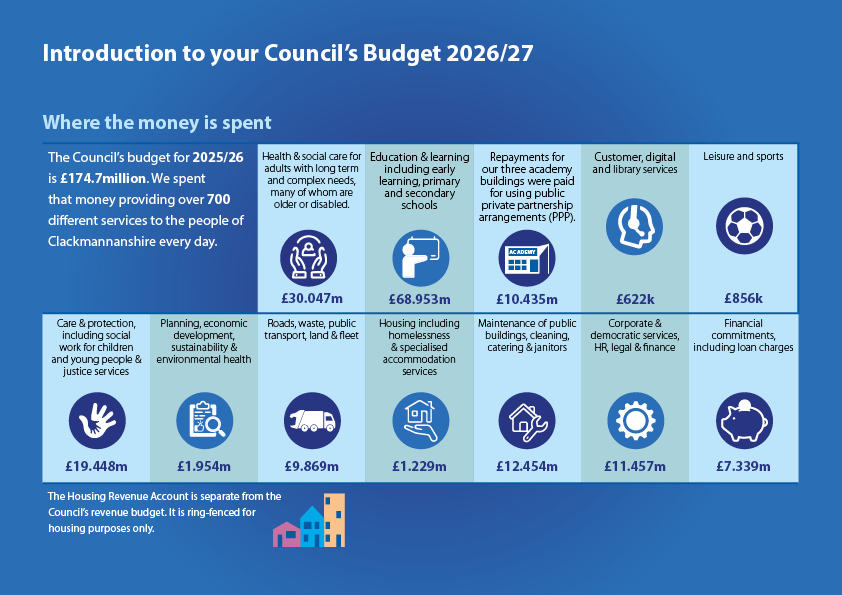
The cost of providing these services has continued to rise substantially in the past few years, along with a significant rise in demand for services such as social care.
At the same time, the amount the Council receives to run services for the people of Clackmannanshire, which comes mostly from the Government, is not enough to meet the rising costs we face. That means we face a budget gap of £7.340 million and savings must be made.
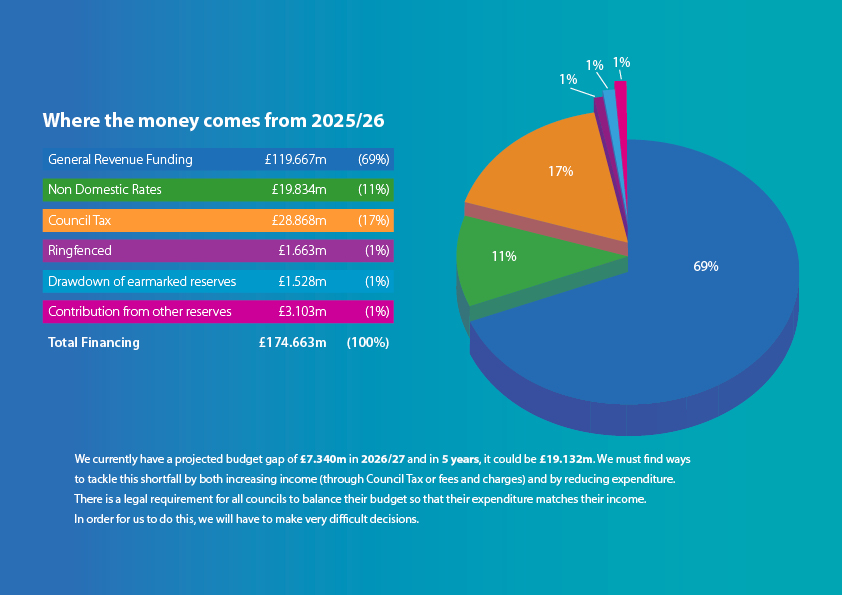
Planning for this year’s budget is more complex, as the Scottish budget announcement will not take place until mid January, resulting in increased uncertainty about exactly how much the Council will be awarded by the government.
The Council is working hard, despite these challenges, through our Be the Future programme to transform our local economy and tackle poverty and inequality to drive long term sustainable change, ensuring financial sustainability.
We’ve already made significant savings over a number of years to ensure we meet our legal obligation to balance our budget. By 2028/29, we will have reduced our spending by the very significant amount of £100 million. Despite those savings, we still face a real shortfall between our funding and the cost of the services we deliver.
The Council must prioritise services and budgets while continuing with our transformation plans. Even where we are legally required to provide services, it is likely that the level of provision will need to be reassessed, or models of delivery will look different.
That means some further difficult decisions must be made and we want to hear our resident’s views on the suggestions that will be presented so that the available funding can be focussed on where it can make the greatest impact.
Last year’s budget was agreed following a series of engagement activities where we asked local people what services were important to them. This feedback was reflected in the decisions that councillors made in agreeing the budget.
Why your views matter
To inform the process of budget setting by councillors, Council officers have put forward a range of options which span many aspects of current service provision.
Some of these options would result in a significant reduction from existing levels of service or removal of the service. There are also options to change the way in which some services are delivered to reduce costs and changes are proposed on fees and charges.
The options are set out alongside an indication of the level of savings which would be achieved if councillors accepted them.
Officers are continuing to work to identify any further options for the coming years, as well as considering other ways of generating additional income to bridge the gap.
Your views are sought on the impacts any of the savings options put forward by officers would have on you or your community.
No decisions have been made and none will be taken by councillors until after the engagement exercise is complete.
Please fill in our short survey to let us know your views, and help influence this year’s difficult work to set a balanced Council budget.
The consultation should only take around 5-10 minutes of your time.
If you would like help with filling in this online consultation, you can visit your local library/CAP and ask staff there to help you.
Also, if you would like further information on any of the proposals, please email: consult@clacks.gov.uk.
What happens next
We will publish a summary of the results at the end of the consultation via this page.
Areas
- All Areas
Audiences
- Anyone from any background
Interests
- Budget
Share
Share on Twitter Share on Facebook